



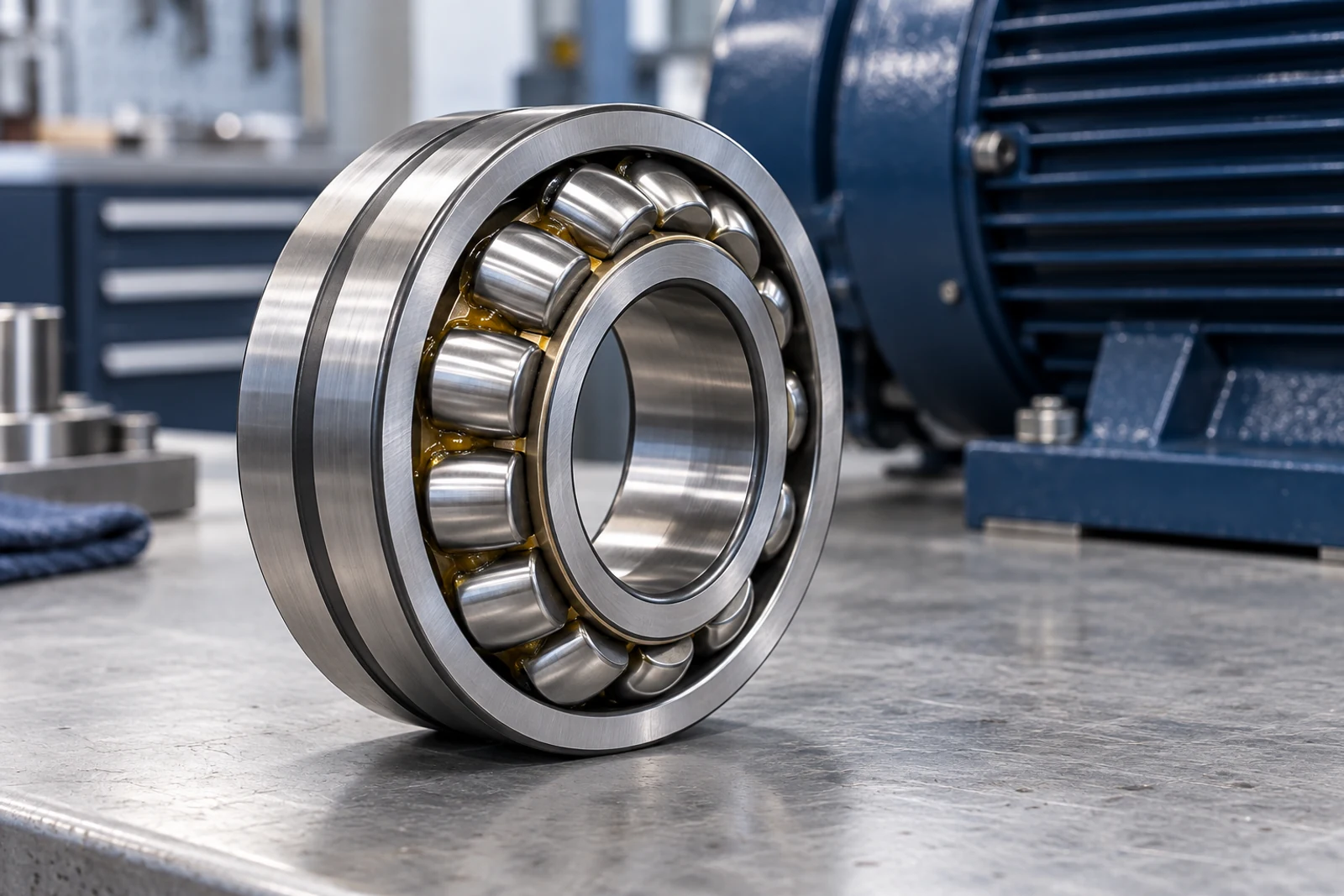
Illustrative worked scenario
A motor's drive-end bearing normally reads 61°C at a steady production load, measured at the same marked point on the housing. After relubrication, it reads 66°C at 10 minutes, 71°C at 25 minutes and 75°C at 40 minutes.
Motor current and vibration remain close to baseline. The OEM-specified grease relief outlet is found blocked, and the dispensed mass cannot be reconstructed because the gun output was never checked.
Do not treat that rising curve as a request for more grease. Hold further lubrication, apply the site's operating and alarm rules, validate the measurement, then reconstruct the product, quantity, gun, feed point and outlet path. The restricted outlet and unknown dose are actionable findings. They are not proof of bearing damage.
In this worked case, the equipment is made safe and the outlet is restored under the machine-specific procedure. Monitoring resumes at the same point and operating condition. The curve flattens, then falls. The event closes only after the readings, corrective action and revised work instruction are recorded.
Immediate checks
What to do before adding more grease.
Hold further lubrication while you establish the temperature trend and reconstruct the task.
- 01Hold
Apply the asset operating and alarm procedure. Do not add more grease during the initial assessment.
- 02Validate
Repeat the reading at the marked point with the same method and comparable operating conditions.
- 03Trend
Record values against elapsed time, then compare motor current, vibration, sound and outlet condition.
- 04Reconstruct
Confirm product, measured mass, gun output, feed point, outlet path and machine state.
Decision 01
Validate the temperature reading.
Before diagnosing the bearing, confirm that the number represents the same location under comparable conditions. A housing-surface reading is a proxy for bearing temperature. NSK notes that direct outer-ring measurement is preferable where the machine design provides suitable access.
- Identify the source: installed RTD, contact probe or infrared camera
- Measure the same marked location on every round
- Record the instrument ID, timestamp and measurement method
- For infrared measurements, record emissivity and reflected apparent temperature; avoid uncorrected readings from bare reflective metal
- Apply the camera manufacturer's IR-window compensation when measuring through a protective window
- Keep distance, angle, focus and measurement area consistent
- Record load, speed, motor current, ambient temperature and cooling condition
- Cross-check an unexpected value with an installed RTD or contact method when available
- Treat a changed point, instrument or operating condition as a new comparison
A changed point, instrument or operating condition breaks the comparison. Restore a like-for-like comparison or cross-check the changed method. Do not redefine an abnormal reading as normal or delay the site's alarm response.
Decision 02
Classify the trend.
Conceptual response patterns only. They are not alarm limits, time limits or diagnostic signatures.
- Trends back toward prior baseline
Can be consistent with grease redistribution. Confirm machine limits and companion signals.
Time relative to relubricationNot to scale - Levels off above prior baseline
Check the documented normal range and operating limits before accepting the new steady state.
Time relative to relubricationNot to scale - Continues rising
Apply the site and manufacturer response. Do not add grease to suppress the trend.
Time relative to relubricationNot to scale
Decision 03
Reconstruct the relubrication event
Reconstruct one event before changing the machine again. Record the approved product and container, measured or estimated dispensed mass and its basis, gun output, feed point, outlet condition, machine state and any change in load, speed or cooling.
Stroke count is not a controlled quantity until the identified gun has been checked by mass with that grease and a full stroke. If any answer is unknown, record it as unknown. Do not replace missing evidence with an estimate from a similar machine.
- Approved product, container and batch can be identified
- Stroke-based mass is an estimate from the identified gun's checked output and setting; record the verification method, and confirm the primed feed path separately
- The fitting serves the intended bearing and the feed passage is open
- The specified outlet was prepared and handled correctly
- Machine state, load, speed and cooling remained comparable
Decision 04
Rank the probable cause.
Start with measurement quality, then match the observed condition to the next controlled check.
| Possible explanation | Evidence to look for | Next controlled check |
|---|---|---|
| Measurement or location error | Point, instrument, emissivity, angle or operating condition changed; an installed sensor disagrees | Repeat at the marked point with verified settings and cross-check another method |
| Grease redistribution | The rise begins after relubrication, then the slope slows or reverses while companion signals remain stable | Continue approved monitoring within machine and site limits; do not add more grease |
| Excess quantity or restricted outlet | Delivered mass exceeds the instruction or is unknown; gun resistance rises; the outlet is blocked or incorrectly configured | Stop pumping; compare actual mass with the instruction and verify the feed and outlet route |
| Wrong or incompatible grease | Product changed, label is uncertain, leakage or stiffness appears after changeover | Stop the lubrication task; verify product approval, mix history and compatibility |
| Grease did not reach the bearing | A remote line or fitting is blocked, the route is uncertain, or expected evidence at the specified relief point is absent | Verify the drawing, fitting, line and relief route under the approved safe procedure |
| Operating or cooling condition changed | Load, speed, current, ambient temperature or airflow changes with the temperature | Restore a like-for-like comparison or investigate the process and cooling change |
| Mechanical, seal or fit problem | The local rise continues after lubrication variables are verified; vibration, noise or current also changes | Escalate for mechanical condition assessment; do not mask the symptom with grease |
Measurement or location error
Grease redistribution
Excess quantity or restricted outlet
Wrong or incompatible grease
Grease did not reach the bearing
Operating or cooling condition changed
Mechanical, seal or fit problem
Decision 05
Use the instruction for the exact machine
The response comes from the instruction for the exact machine, not from a universal purge time or stroke count. A metered quantity still needs a viable path through the arrangement. A blocked, painted-over, hardened or incorrectly configured outlet can trap grease and pressure.
Operating state, outlet handling and the time before reclosing vary by machine. Rotate or run only when the equipment procedure authorizes it and site controls permit the task. Record the manufacturer, model, document number and procedure revision used for the decision.
Optional engineering aidEstimate a replenishment quantityUse only when the OEM quantity is unavailable and the bearing arrangement is verified.
Replenishment estimator
Estimate replenishment quantity from bearing dimensions.
This SKF-based estimate applies only to routine replenishment of applicable bearing arrangements. Confirm the feed route from the bearing drawing or machine manual before selecting a coefficient.
- Gp
- estimated replenishment quantity, grams
- D
- bearing outside diameter, mm
- B
- bearing width, mm, for the applicable radial bearing arrangement
No estimate is calculated until the required fields are complete.
Use the machine manufacturer's quantity when available. This SKF-based estimate covers routine replenishment through an already primed feed path. It does not include filling empty or newly replaced feed lines. Do not use it for sealed-for-life bearings, initial fill, relubrication intervals, automatic-system settings, flushing or product changeover. This version does not cover the T and H dimension conventions used for tapered roller and thrust bearings.
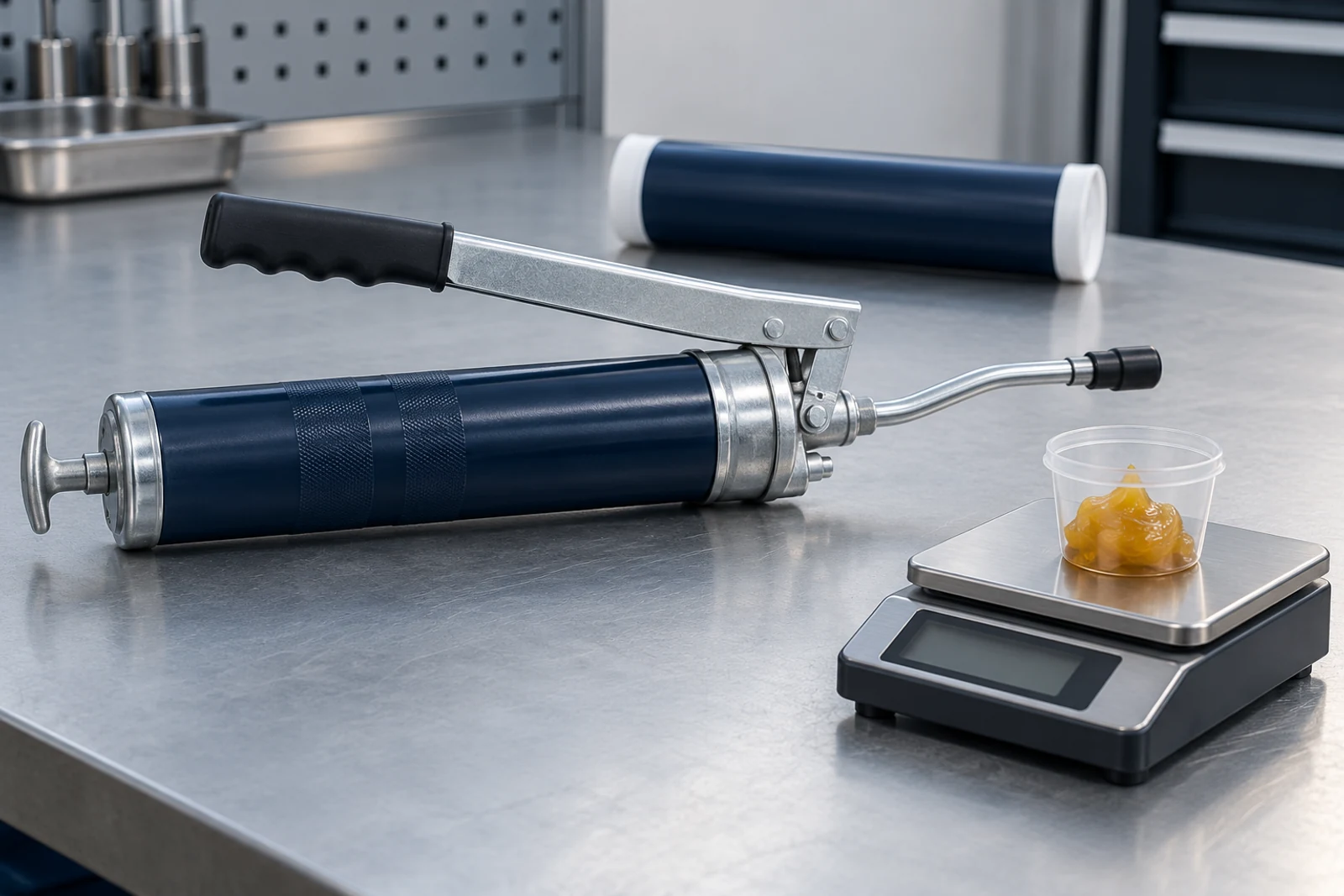
Gun output can vary with backpressure, condition and settings. Stroke counts estimate dispensed mass; they do not prove delivery into the bearing. Use a metered delivery tool suited to the target quantity when full strokes cannot deliver it reliably. Do not round the dose to a whole stroke or assume partial trigger travel is calibrated.
Escalation signals
When to escalate beyond routine monitoring.
Apply the site's operating, alarm or condition-monitoring response when any of these conditions appears.
- Temperature continues to rise or settles outside the asset's documented normal operating range
- A site or manufacturer alarm, trip or operating limit is reached
- Vibration, ultrasound, audible noise or motor current changes with the temperature
- The grease identity, amount or compatibility cannot be verified
- Grease leakage, smoke, an abnormal odor or visible seal distress appears
- The fitting or outlet path appears blocked, damaged or incorrectly configured
Decision 06
Record the evidence and correct the task.
If the team cannot reconstruct the product, amount, gun, time, load and outlet condition, the lubrication record is incomplete.
After the immediate event is addressed, update the task instructions with the approved grease, the quantity in the OEM-specified unit or verified grams where appropriate, the identified tool, feed point, outlet method, operating state, required observations and escalation rule.
- 01
Asset ID, bearing location and marked measurement point
- 02
Instrument ID, method, normal range and alarm reference
- 03
Grease product, container identity and actual mass delivered
- 04
Gun ID and verified grams per full stroke
- 05
Feed point, outlet condition and machine operating state
- 06
Manual, procedure number and revision used
- 07
Most likely cause and evidence supporting the decision
- 08
Immediate action, machine status, owner and closure evidence
- 09
Work instruction change and similar assets requiring review
- 10
Next inspection or sample date
| Event point | Elapsed time | Temperature | Operating context | Companion signals and outlet |
|---|---|---|---|---|
| Baseline | Before task | |||
| Relubrication | 0 min | |||
| Follow-up | ||||
| Follow-up | ||||
| Decision point |
A lubrication event is not closed when the temperature falls. It is closed when the cause, action and revised task can be reconstructed from the record.
Common questions
Common questions about post-greasing temperature rise.
Is a temperature rise after greasing always overgreasing?
No. Excess grease and a restricted outlet are possible explanations, but a brief rise can occur while grease redistributes. Wrong or incompatible grease, a blocked feed route, seal drag, changed load or cooling, misalignment and bearing damage can produce similar symptoms. Use the trend and companion condition signals before deciding.
How hot is too hot for a greased bearing?
There is no single safe number for every bearing, grease, motor and operating condition. Use the equipment manufacturer's limits, the site's alarm response and the asset's established baseline. A continuing rise or a stable temperature above the asset's normal range should be investigated.
Should the outlet be left open for 30 or 60 minutes?
Do not apply a universal time. Motor and bearing procedures differ. Follow the machine-specific instruction for opening, cleaning, operating and reclosing that outlet.
Can we grease the bearing while the machine is running?
Only when the equipment procedure explicitly authorizes live relubrication and the guarding and site risk controls permit it. Procedures differ. For example, ABB's MN442 manual recommends relubrication with the motor stationary and warm. Follow the instruction for the actual machine, not a general rule about greasing while running.
Is the SKF Gp formula the exact grease dose?
No. It is a guideline replenishment quantity for defined delivery arrangements. The equipment nameplate, bearing arrangement and manufacturer instructions take priority. Use the formula as an engineering starting estimate only when the required dimensions and feed route are confirmed.
Primary references
These sources support the numerical guidance and procedure cautions used in this article.
- SKF: Grease relubrication procedures and replenishment quantities
- SKF: Rolling bearings, selecting grease or oil
- ABB: RPM AC motor installation and maintenance instructions, MN442
- Timken: Bearing maintenance guidance
- NLGI: Grease compatibility and seal-compatibility FAQs
- NSK: Bearing operation inspection and abnormal-temperature checks
- FLIR: Parameters that affect infrared temperature measurement
New field notes
Get one practical lubrication field note each month.
Clear guidance on lubrication, oil analysis and reliability improvement. No daily emails.