
Your First Coolant Report: What an Oil Analyst Should Keep and Change
Good sampling and careful reasoning still matter. Learn which habits transfer, which rules change and what one simple dilution calculation can actually tell you.
 By KNV Subrahmanyam6 min read

You know how to read an oil report. Then a colleague hands you results from a cooling loop: glycol concentration, pH, conductivity and copper. The layout looks familiar. Should the maintenance decision be familiar too?
Some of your best habits still apply. Take a representative sample. Check its identity. Compare it with a useful baseline. Ask what changed before recommending an intervention. But the fluid's job, chemistry and operating requirements are different. An oil alarm limit is not a coolant limit, and a familiar test name does not make the interpretation interchangeable.
For a lubrication professional learning coolant analysis, the starting point is to separate the reasoning you already know from the rules you still need to learn.
Keep the discipline behind a good sample
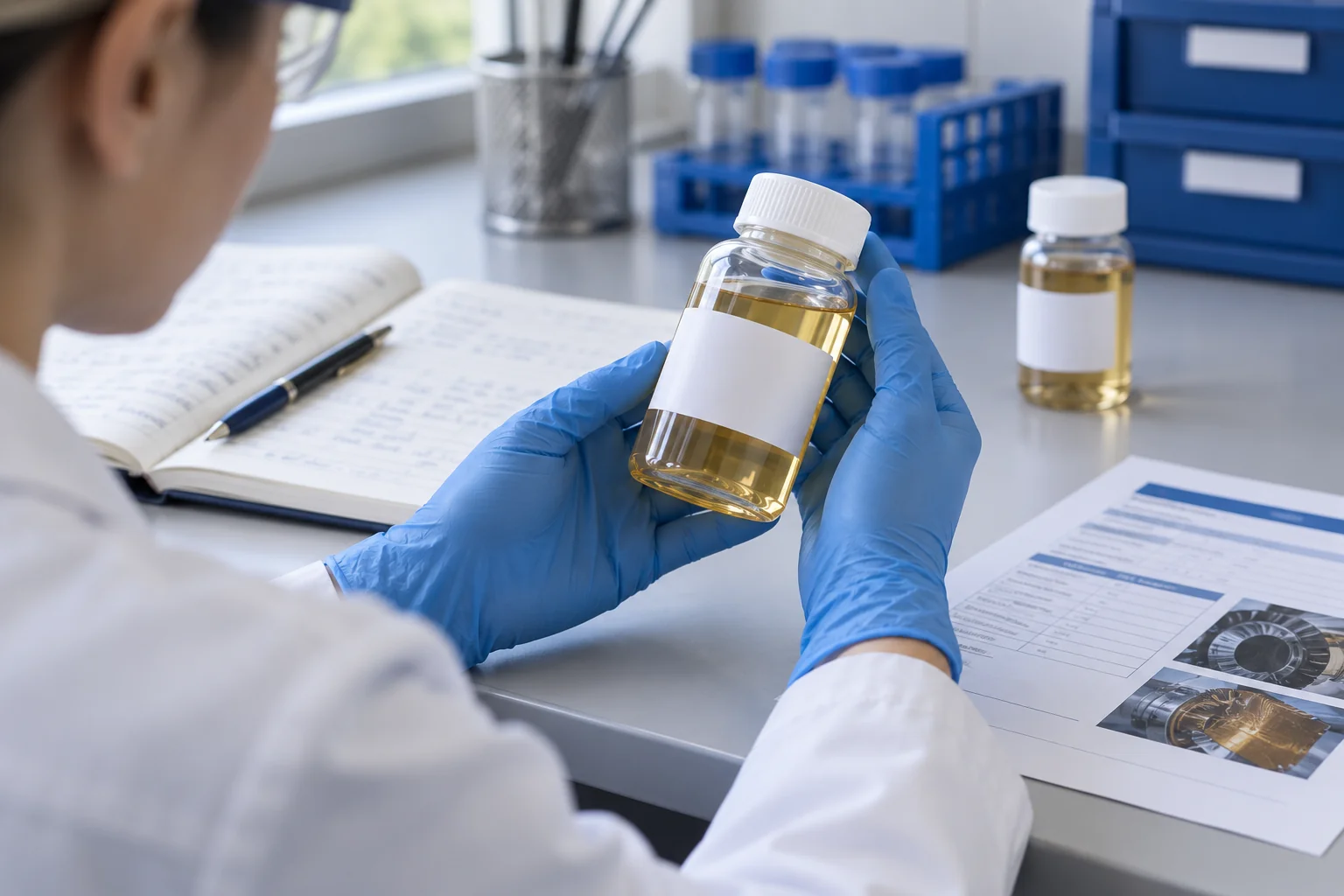
A result is only useful if you know what the bottle represents. Record the loop, sampling point, fluid product, operating state and recent maintenance. Use the container, flushing procedure and handling instructions specified for that system and test. A sample for microbial testing may need different handling from one intended for metals analysis.
The principle transfers. The exact procedure does not. Do not import a hydraulic-system flush volume or fit a familiar sampling valve without checking coolant compatibility and the equipment maker's instructions.
Our guide to where you take an oil sample explains why location matters. Apply that same question here: does this port represent circulating fluid, or an isolated pocket? Keep the answer in the sampling record, so another person can reproduce the work.
Change the meaning before changing the limits
Water in lubricating oil is often something to investigate. In a water-glycol cooling fluid, water is part of the formulation. The useful questions become: which product is installed, at what concentration, and is its chemistry suitable for the equipment?
Likewise, a rising metal result is a clue, not a component name. Check the materials in contact with the fluid, the maintenance record and the laboratory method before calling copper a wear signal. A fluid sample does not tell you, on its own, whether the metal came from corrosion, contamination or another route.
Test selection also changes. As one product-specific example, Castrol's PG25 operating guide lists coolant tests including glycol concentration, pH, reserve alkalinity, elements and inhibitor analysis. Its method list is not an oil-analysis test panel. Agree the appropriate panel with the fluid supplier and a laboratory that can perform it.
Conductivity needs similar care. ASHRAE's guidance distinguishes facility water from the technology cooling loop serving the IT equipment. Identify the fluid and loop before using any water-quality table. A number without its applicable specification can create a false alarm or false reassurance.
Learn who owns the decision
Before accepting responsibility for a coolant sample, identify four things:
- The approved fluid: the actual product and concentration, not its colour or an informal description.
- The equipment requirements: compatible materials, filtration and operating conditions.
- The test requirements: method, sampling procedure, baseline and limits applicable to that fluid.
- The response plan: who reviews an abnormal result and who can approve an addition, treatment or replacement.
A lubrication qualification is useful evidence of learning within its scope. It is not a blanket authorization to prescribe coolant treatment. That responsibility needs the relevant training, procedures and employer authorization.
Castrol's guide, for example, calls for confirmation of an out-of-specification result and consultation with the supplier. This is a useful habit to carry across: verify the evidence before choosing a remedy. It is not permission to apply one supplier's response to every fluid.
Try one calculation before choosing an explanation
Training example, not a customer result. A fictional loop contains 400 litres of fluid at 26% glycol by volume. The service record says 20 litres of glycol-free water were added. After mixing, the laboratory reports 24.8% glycol and a higher copper result.
For this simplified exercise, assume the stated volumes are additive, the starting volume is known, no other fluid entered or left, and both samples represent the mixed loop.
- Glycol already in the loop
- 400 L × 26% = 104 L
- Total fluid after the top-up
- 400 L + 20 L = 420 L
Predicted concentration104 ÷ 420 ≈ 24.8%
The loop initially held 104 litres of glycol. Under those assumptions, the predicted concentration is 104 divided by 420, or about 24.8%. The measured concentration is consistent with the logged dilution. That is a useful conclusion, but it is a limited one.
It does not establish that 24.8% meets this loop's requirements. It does not explain the copper increase. And it does not prove that adding water was an approved maintenance action.
The next step is to confirm the copper result and inspect the service record. What water was used? Was the top-up container clean? Was any work done on the loop? If a retained water sample exists, it can help test a contamination hypothesis. Do not dismiss that possibility using a coolant's in-use metal limit: that limit does not tell you what was actually in the added water.
We have deliberately left pH out of this calculation. Its response depends on buffering, the chemistry of the added water and the measurement method. It cannot be treated as another concentration in this simple volume balance.
Take a decision record back to work
For your next training exercise, write down the result, the exact specification it should be compared with, the service event that might explain it and the next check needed. Then ask a second person to review the proposed action. Can they follow your reasoning without guessing what was in the bottle?
This is also where fluid analysis meets operating context. Reliability Engine's coolant health monitoring overview connects chemistry and particle trends with flow, pressure and service history. It is a useful next read on how a coolant result fits into the wider cooling system, not a replacement for the fluid's own specification.
An experienced oil analyst has a strong starting point. The skill to keep is disciplined interpretation. The skill to add is knowing when a familiar-looking result belongs to a different set of rules.
References
- Castrol ON Direct Liquid Cooling PG25: operating guide, sections 2, 5 and 6. Product-specific compatibility, sampling and analysis guidance.
- ASHRAE TC 9.9: Water-Cooled Servers, Common Designs, Components, and Processes, 2019. Facility and technology cooling loops and water-quality considerations.
New field notes
Get one practical lubrication field note each month.
Clear guidance on lubrication, oil analysis and reliability improvement. No daily emails.