


Water in Oil: Read the Report Before You Blame the Cooler
A rising water result can come from the machine, the sample or the test. Learn to check all three, then use the timing of the rise to decide whether an oil cooler deserves a pressure test.
- Worked example
- Trend exercise
- Cause table

Illustrative worked scenario
A hydraulic unit’s oil report from 24 March flags water at 540 mg/kg. For the previous three months it read between 120 and 135.
The unit holds 400 litres of ISO VG 46 hydraulic oil, runs at about 50 °C and has a water-cooled oil cooler. At the review meeting, the first suggestions are a cooler leak and an oil change.
The cooler may well be the cause. But a water number has three possible authors: the machine, the sample and the test. An oil change today would also hide where the water came from. Check the units and method, resample from the routine valve and pull the operating log. Then let the timing decide whether the cooler has earned a pressure test.
In this article
The 24 March report
Read the units and the test method first
On a Karl Fischer report, mg/kg is the same as parts per million by mass. So 540 mg/kg is 0.054 percent, and 1 percent is 10,000 ppm. A result in volume percent is on a different basis, because oil is lighter than water. Before comparing two reports, check that the units and the basis match.
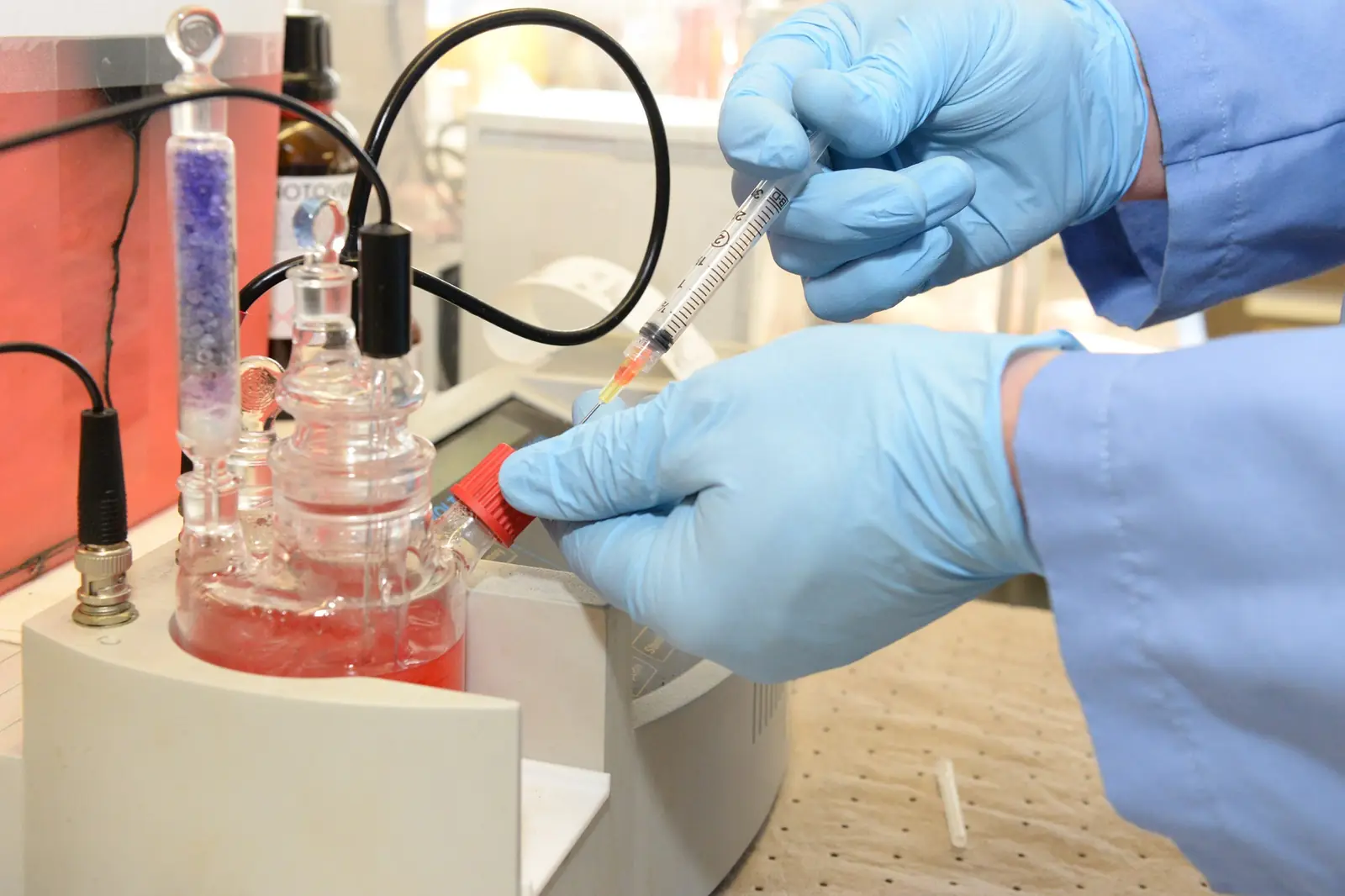
Laboratories typically measure water in oil by Karl Fischer titration, in which a reagent reacts with the water in a weighed sample. The coulometric version used for oils is standardised as ASTM D6304. Some sulfur-containing additives can also react with the reagent and count as water, as NIST researchers noted in 2004. Metrohm, a titrator maker, advises heating such oils in an oven and sending just the vapour to the titration cell, which lowers the interference without always removing it.
Keep the laboratory and method the same for a trend, and if a result jumps, ask whether the oil was injected directly or heated in an oven. Here the laboratory confirmed the oven method used for every earlier report, which rules out a change of test.
About a teacup of water, spread through 400 litres of oil. No level gauge will register that, so the laboratory result may be the only sign.
Referenced here ISO 12937 preview; Mobil turbine oil guide; NIST oven study; Metrohm AB-209; Chevron water bulletin
Clear oil can still hold water
Water in oil can be dissolved, emulsified as fine droplets that make the oil hazy, or free and settled at the bottom. How much an oil can dissolve, its saturation point, depends on the base oil, additives, age and temperature. In Pall’s example of a typical hydraulic fluid, the same 200 ppm is about 80 percent of saturation at a 15 °C start-up and 40 percent at 50 °C, while the Karl Fischer result does not move.
So oil that is clear at running temperature can turn hazy on a laboratory bench. The US Bureau of Reclamation’s lubrication manual says to let a sample stand at room temperature for at least 24 hours before judging its appearance, and treats haze only as a possible sign of water. Haze from water means the oil held more than it could dissolve at that temperature. It does not say how much.
Clear oil is not proof of harmless oil either. In full-scale tests published in 1977, R. E. Cantley found tapered roller bearing fatigue life fell as water in an SAE 20 oil rose from 25 to 100 to 400 ppm. That is one oil and one bearing type, not a limit for this unit.
Referenced here Pall: water content as percent of saturation; Reclamation FIST 2-4; Cantley 1977, abstract
The 7 April resample
Check what the bottle represents
Free water and sediment settle. Reclamation, writing about bearing oil tubs in hydro plants, warns that a drain-line sample from the bottom of the tub will likely give “a much worse picture” of the oil’s condition. Mobil’s turbine oil guide lists bottom samples among the causes of a high water result.

Keep these the same from one sample to the next, and write any change on the label:
- The same valve each time, on flowing oil, with the stagnant oil in the line flushed out first
- The machine at its normal operating state, with the time since start-up recorded
- A clean, dry, sealed bottle, kept closed until it reaches the laboratory
Our guide to where you take an oil sample explains how to choose the point. Before a result changes the maintenance plan, confirm it with a second sample from the routine point.
This unit’s resample from the same valve on 7 April read 520 mg/kg. The rise is real.
Referenced here Reclamation FIST 2-4, section 5.1.1.1; Flender 7300en, section 7.3.1; Mobil turbine oil guide, appendix 1
Published limits
Judge the number against this machine
Published water limits differ several-fold between machines and oils:
| Equipment and source | Published water guidance |
|---|---|
| Flender gear units, mineral, PAO and ester oils (instructions 7300en, version 07/2026) | Below 300 ppm within tolerance. From 300 to 600 ppm, still within tolerance: note the change and contact Flender. Above 600 ppm, find and remove the cause, and change the oil if necessary. |
| Bosch Rexroth hydraulic components, mineral oils (RE 90220, edition 09.18) | Must stay below 1,000 ppm. Below 500 ppm recommended for long life. |
| Siemens/Westinghouse turbines (OEM limit as compiled in Mobil’s turbine oil guide, 2022 edition) | 200 ppm maximum |
| Solar Turbines gas turbines (OEM limit as compiled in Mobil’s turbine oil guide, 2022 edition) | 2,000 ppm maximum |
Published examples only, each for its own equipment and oil, and possibly revised since. Water-dissolving polyglycol gear oils have far higher bands in the same Flender table.
Use the limit set for this machine by its maker, the oil supplier or your monitoring programme, and read the result against the machine’s own history. Mobil’s turbine oil guide gives similar advice about its own interpretation guidelines: treat them as a general guide, and take corrective action only with guidance from the equipment maker or the lubricant supplier.
The plant in this example follows the Rexroth figures for its hydraulic units. At 540 mg/kg the oil is above the 500 recommended for long life but under the 1,000 ceiling: worth acting on, not an emergency. The bottles turned faintly hazy on the bench, but no free water settled in them or showed in the sight glass. So once the resample confirmed the rise, the oil was dried in mid-April by a method the supplier accepted, and the search went on.
Referenced here Flender 7300en, table 7-2; Bosch Rexroth RE 90220; Mobil guide, appendices 1 and 2
January to June
Look at when the water arrived
Drying lowered the number. It did not explain it. In May, a second stop brought a second rise. By June, the history looked like this.

The cooler
Test the cooler theory with evidence from both sides
Some oil coolers are designed to keep the oil at a higher pressure than the cooling water, so that a leak sends oil out rather than letting water in. A 1994 CANTEACH training module for CANDU nuclear stations describes this arrangement and warns that water can still leak in during a shutdown, when the oil is no longer pressurised.

Reliability Engine’s explainer on heat exchanger leaks in data-centre cooling loops shows the same rule with a pressure slider: shift the balance across a breach and the leak reverses. Its fluids and limits differ from a hydraulic unit, but its advice carries over: look for evidence on the side that receives the leak.
Condensation fits the same timing: a reservoir that cools during a stop in humid weather draws moist air in. Bosch Rexroth lists condensation as a way water enters hydraulic fluid, and recommends an air dehumidifier at the reservoir vent in humid conditions.
Each remaining source leaves a different trace:
| Possible source | How it shows on the trend | Evidence outside the report | Next check |
|---|---|---|---|
| Condensation during stops | Rises across stops, often larger in humid weather | Similar units with similar breathers rise too | Inspect the breather and vent; compare neighbours |
| Cooler leak while stopped | Rises across stops when the cooling water stays on | Cooling water on during each stop; neighbours unaffected | Compare cooler pressures in each state; integrity test |
| Cooler leak while running | Where oil runs above water pressure, little or no rise | Oil in the cooling water; unexplained oil top-ups | Check the water side and the oil consumption |
| Wet top-up oil or washdown | Rises that follow top-ups or cleaning, which are often done during stops | Top-up and cleaning records | Test the top-up stock; review washdown practice |
Condensation during stops
How it shows on the trend
Rises across stops, often larger in humid weather
Evidence outside the report
Similar units with similar breathers rise too
Next check
Inspect the breather and vent; compare neighbours
Cooler leak while stopped
How it shows on the trend
Rises across stops when the cooling water stays on
Evidence outside the report
Cooling water on during each stop; neighbours unaffected
Next check
Compare cooler pressures in each state; integrity test
Cooler leak while running
How it shows on the trend
Where oil runs above water pressure, little or no rise
Evidence outside the report
Oil in the cooling water; unexplained oil top-ups
Next check
Check the water side and the oil consumption
Wet top-up oil or washdown
How it shows on the trend
Rises that follow top-ups or cleaning, which are often done during stops
Evidence outside the report
Top-up and cleaning records
Next check
Test the top-up stock; review washdown practice
Possible sources from Mobil’s turbine oil guide, the CANTEACH module and Bosch Rexroth RE 90220. The trend signatures and next checks are our interpretation for this example, not quotations.
If the cooling water is treated, ask the laboratory whether sodium or boron is rising in the oil, and send a cooling-water sample for comparison. Oil additives can contain both elements, and sodium can also come from hard water, so compare with an analysis of the new oil first. With only about 0.14 L of water per stop, the elements may not rise enough to measure, so a flat result does not clear the cooler.
When the evidence points to the cooler, have authorised people test it by the maker’s procedure. Alfa Laval’s gasketed plate heat exchanger manual, for example, pressure-tests one side at a time with the other side open to ambient pressure.
Referenced here CANTEACH turbine lubricating oil module; Bosch Rexroth RE 90220; Mobil guide, appendix 1; Alfa Laval gasketed PHE manual
Act now
When not to wait for the investigation
Find the source in parallel, but protect the machine first.
- Free water or milky oil is visible in a sight glass or a fresh sample. Reclamation’s practice is to purify the oil and send samples from before and after purification to the laboratory.
- The result exceeds this machine’s limit. Follow the action set by the maker or your programme.
- Water keeps climbing while the unit runs. The ingress is continuing, so the search cannot wait for the next stop.
- Oil appears in the cooling water, or the oil level falls with no explanation. The CANTEACH module calls for prompt action to find and stop a cooler leak that sends oil out.
Write the decision down
A short review record keeps the reasoning visible to the next person and stops the same report being argued again next month.
Back to the March meeting. The oil did not need changing that day, and the cooler had not yet earned a pressure test. By June the timing had narrowed the suspects to the cooler and condensation. If the water side reads higher at the next stop and the neighbouring units stayed flat, test the cooler. A water case closes when the record shows where the water came from.
Common questions
Common questions about water results
Is a negative crackle test good enough to clear a sample?
No. Reclamation’s manual says the hot-plate crackle test gives no quantitative result, and Chevron’s marine bulletin puts its detection threshold near 0.1 percent, about 1,000 ppm. A negative test could still hide this unit’s 540.
Can we just drain the water from the bottom of the reservoir?
Only the free water. Bosch Rexroth notes that dissolved water needs other treatment. Pall’s oil purifier data sheet adds that coalescers and centrifuges remove water only down to the oil’s saturation point. Reclamation’s manual describes vacuum dehydration, which uses heat and vacuum to remove water as vapour.
Does a high water result mean the oil must be changed?
Not automatically. Remove the water and find the source first. Flender’s instructions say the oil manufacturer decides whether the oil is still usable, so share the test results with your supplier.
Primary references
The sources behind the measurements, limits and procedures in this article.
- Margolis, Vaishnav and Sieber (NIST): Measurement of water by oven evaporation, Analytical and Bioanalytical Chemistry 380 (2004)
- Metrohm Application Bulletin 209/3: Water in insulating oils, hydrocarbons and their products (2019)
- ISO 12937:2000: Coulometric Karl Fischer titration method (official preview)
- Chevron Marine Lubricants Information Bulletin 2: What About Water? (2019)
- Pall: Measuring water content as percent of saturation
- Pall: HNP023 series oil purifier data sheet (MEHNP023ENc, 2022)
- US Bureau of Reclamation FIST Volume 2-4: Lubrication of Equipment (2024)
- Cantley, R. E.: The effect of water in lubricating oil on bearing fatigue life, ASLE Transactions 20(3), 1977 (abstract)
- Flender: Gear unit lubrication and gear unit preservation, instructions 7300en (version 07/2026)
- Bosch Rexroth RE 90220: Hydraulic fluids based on mineral oils and related hydrocarbons (edition 09.18)
- Mobil: Technical training guide, turbine oil condition monitoring (EN0756SH, 2022 edition)
- CANTEACH Course 234, Module 234-10: The turbine lubricating oil system (1994)
- Alfa Laval: Gasketed plate heat exchangers, industrial line, instruction manual